
July 29, 1858: Japan opens up to trade
On this day in 1858, the United States and Japan signed the Treaty of Amity and Commerce, ending Japan’s long isolationist era.
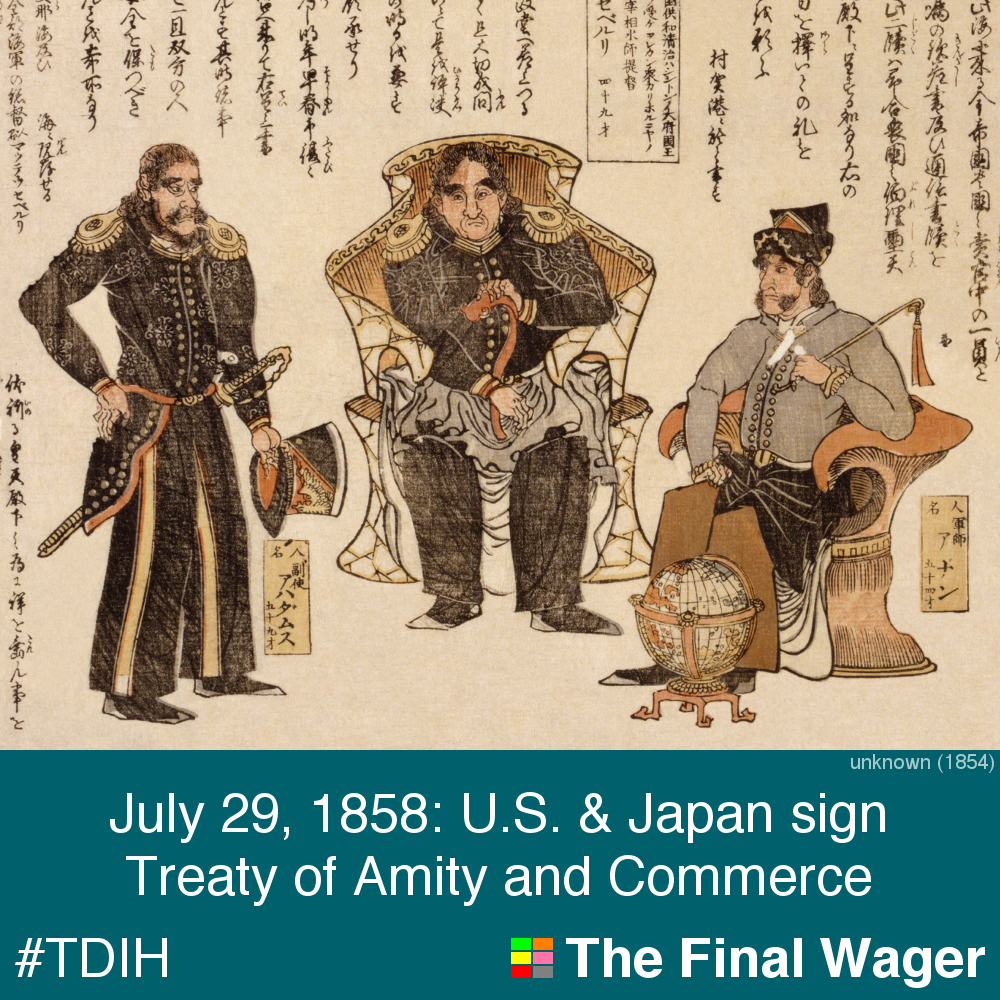
In 1852, President Millard Fillmore instructed Commodore Matthew Perry to open Japan to foreign trade. He was given orders to use “gunboat diplomacy” if necessary.
On July 8, 1853, Perry arrived with his “black ships” at Edo Bay, demanding to see the Shogun. Threatening violence if he didn’t get his way, he shot cannon blanks as a prelude to what might happen. He was allowed to land on July 14 to present a letter, then was asked to leave after giving the Japanese one year to think about the offer.
After spending the winter in Hong Kong, Perry set sail again, landing at Kanagawa (today’s Yokohama) on March 8, 1854; the Convention of Kanagawa was signed on March 31, opening two ports for refueling and permitting the U.S. to open a consulate. The ordeal inspired the Gilbert & Sullivan operetta Pacific Overtures.
The important work – opening Japan to trade – was left to the first consul, Townsend Harris. He negotiated the Treaty of Amity and Commerce, signed on July 29, 1858. It opened five ports to foreign trade and granted foreigners immunity.
Known as “the father of the modern steam navy,” Matthew Perry was the younger brother of Oliver Hazard Perry, another famous commodore. He was awarded $20,000 for his service; he died March 21, 1858. His personal flag was present for the Japanese surrender on the deck of the Missouri in 1945.
Image: anonymous, Gasshukoku suishi teitoku kōjōgaki (Oral statement by the American Navy admiral) (1854)