
Chemistry videos
Here are some videos to help you better understand concepts in chemistry.
GasesCalculations using the combined gas laws & ideal gases All questions come from the overview packet you received at the beginning of the unit |
Covalent bondsLewis structures & molecular polarity |
Molarity & pHMolarityThere is a separate video for each individual sub-question. 1. You would like 375 mL of a 0.400M CaCl2 solution. A. How would you produce this using solid calcium chloride? B. How would you produce this using a 0.900M CaCl2 solution? 2. A cleaning solution is 21.0% sodium hypochlorite (NaClO) by mass. The density of the solution is 0.844 g/mL. A. Find the molarity of this solution. B. You have 175 mL of this solution. How much water do you need to add to make this a 0.500M NaClO solution? C. What volume of the original solution would you need to have 75.0g of NaClO?
pH, pOH, [H+], [OH-]First video: 1. Calculate the pH of a solution with [H+] = 1.0 x 10⁻⁶ M. Second video: 4. I have a solution of HCl with molarity 0.0015. Calculate pH. |
| Mid-term review
MC #50: empirical formula of a compound |
The full playlist of other videos:
Here’s a list of videos so far. If you want something in particular, please let me know.
- Basics of elements: particles, mass, ions, and isotopes
- Isotopes: how to calculate the atomic mass if you know the abundances
- Isotopes: how to calculate the abundances if you know the atomic mass
- Using an ionic compound’s name to derive its chemical formula
- Using an ionic compound’s chemical formula to derive its name
- Converting between molecules and moles using Avagadro’s number
- Basics of acids: what they are, how they’re named
- How to balance equations
- Molar ratios, mass-mass problems, limiting factors, percent yield
Remember the four transition metals that have only one ionic state:
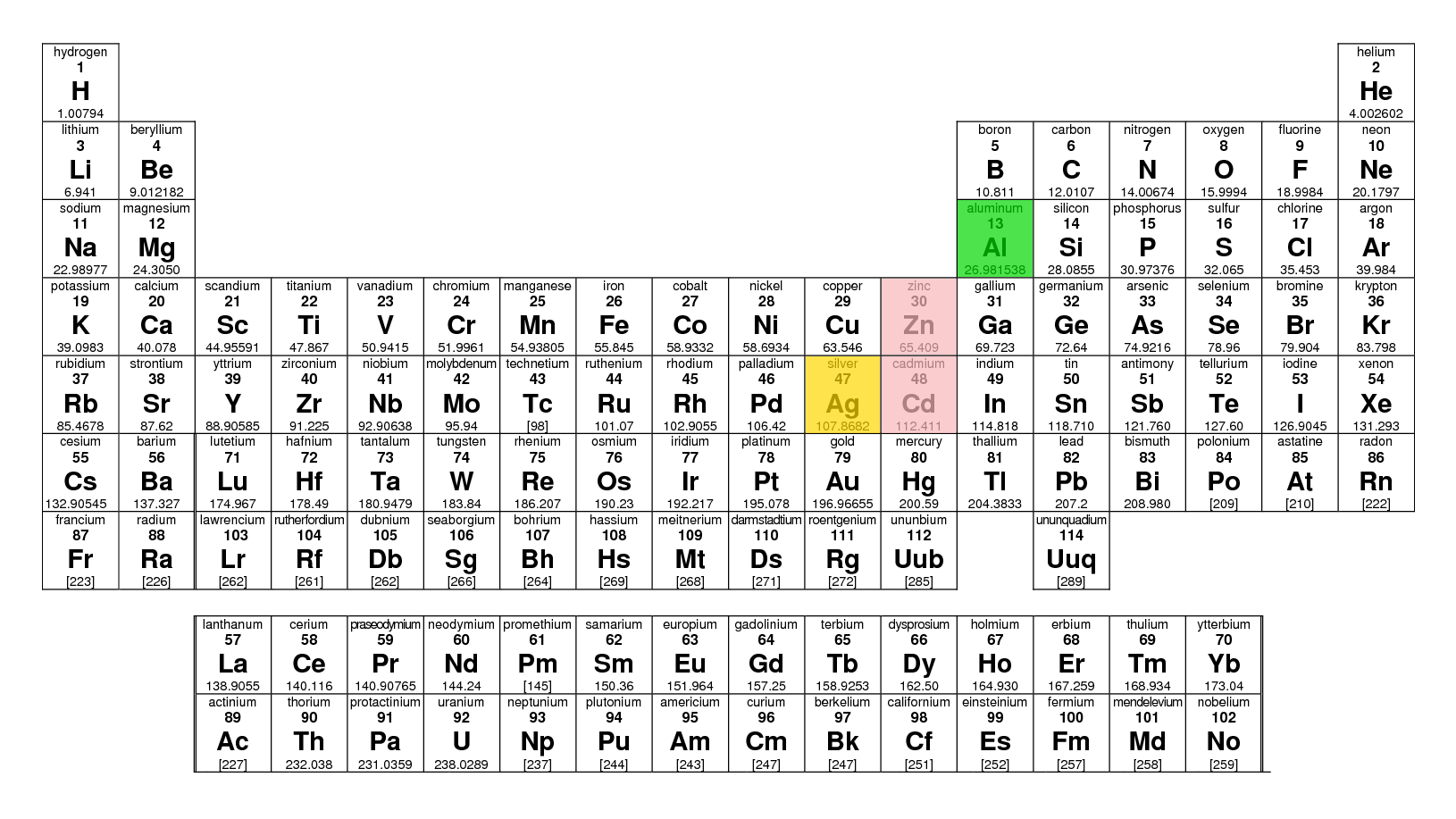 aluminum (Al3+)
zinc (Zn2+)
cadmium (Cd2+)
silver (Ag1+)