
Papal Pandemonium: Quarterfinal #2
| Papal Pandemonium 2015 | ||||||||||||
| Quarterfinals | Semifinals | Finals | ||||||||||
| 1 | 2 | 3 | 4 | 5 | 6 | 7 | 8 | 9 | 1 | 2 | 3 | Results |
For more info on Popes, visit New Advent's Catholic Encyclopedia
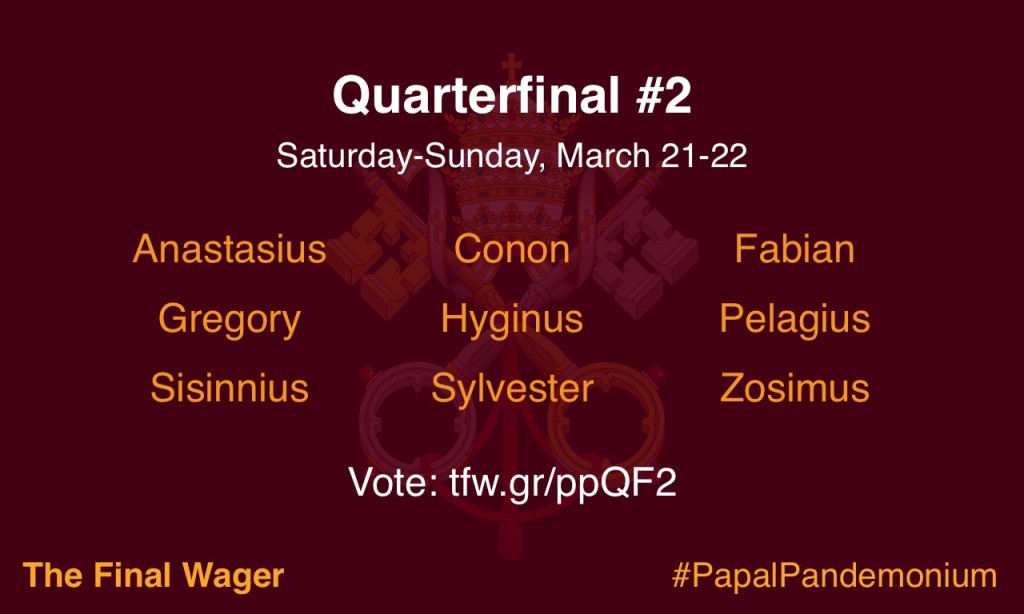
In our inaugural quarterfinal, Hilarius was picked by 82% of our voters; that name will be joined in the semifinals by Eutychian (37%) and Leo (32%).
Our next round closes Sunday evening, so think about it over the weekend while you’re watching March Madness.
Choose your three favorite papal names.
- Zosimus (17%, 17 Votes)
- Sylvester (15%, 15 Votes)
- Sisinnius (15%, 15 Votes)
- Pelagius (7%, 7 Votes)
- Hyginus (14%, 14 Votes)
- Gregory (10%, 10 Votes)
- Fabian (14%, 14 Votes)
- Conon (4%, 4 Votes)
- Anastasius (7%, 7 Votes)
Total Voters: 36
I’ll add more info about these popes as I have time – busy weekend.
Anastasius – used 4 times (last: 1154)
| I✝ | II | III | IV |
| 399–401 | 496–498 | 911–913 | 1153–1154 |
Anastasius II came to power at the height of a schism between the Eastern and Western churches. He sent emissaries to Constantinople to negotiate with the Byzantine Emperor, called Anastasius I (confusing, right)?
The fallout from this and other gestures caused the crisis to deepen; Anastasius II was the second pope (after Liberius) to fail to be canonized, and Dante might have placed him in the sixth circle of hell.
Conon (686–687)
During Conon’s short tenure, he received the missionary Kilian from Ireland.
Fabian✝ (236–250)
Fabian helped to build the catacombs used to bury Christians and his fellow Popes – including his own martyred body.
Gregory – used 16 times (last: 1846)
| I✝ | II✝ | III✝ | IV | V |
| 590–604 | 715–731 | 731–741 | 827–844 | 996–999 |
| VI | VII✝ | VIII | IX | X* |
| 1045–1046 | 1073–1085 | 1187 | 1227–1241 | 1271–1276 |
| XI | XII | XIII | XIV | XV |
| 1370–1378 | 1406–1415 | 1572–1585 | 1590–1591 | 1621–1623 |
| XVI |
| 1831–1846 |
Gregory I, known as the Great, was venerated for his writings. He is the patron saint of musicians, teachers, and students.
Gregory XIII introduced the Gregorian calendar in 1582; it corrected the length of the year of the Julian calendar to keep Easter around the same time of year.
Hyginus✝ (136–140)
His name meant healthy, and he had a healthy appetite for writing, including a treatises on mythology and beekeeping.
Pelagius – used 2 times (last: 590)
| I | II |
| 556–561 | 579–590 |
The first Pelagius was allegedly responsible for the Church of the Twelve Apostles (Santi Apostoli).
Sisinnius (708)
Pope for 20 days, he suffered from a severe case of gout.
Sylvester – used 3 times (last: 1045)
| I✝ | II | III |
| 314–335 | 999–1003 | 1045 |
Sylvester I was the first beneficiary of the Emperor Constantine’s vision at the 312 Battle of the Milvian Bridge, which led to his acceptance of Christianity in the 313 Edict of Milan. He sent emissaries to the first Council of Nicaea (325) but did not attend himself.
Zosimus✝ (417–418)
Some historians believe his father was Jewish.