
July 21, 356 BC: arson clears way for a Wonder
On this day in 356 BC, the second Temple of Artemis at Ephesus, the forerunner of one of the Seven Wonders of the Ancient World, was destroyed by arson.
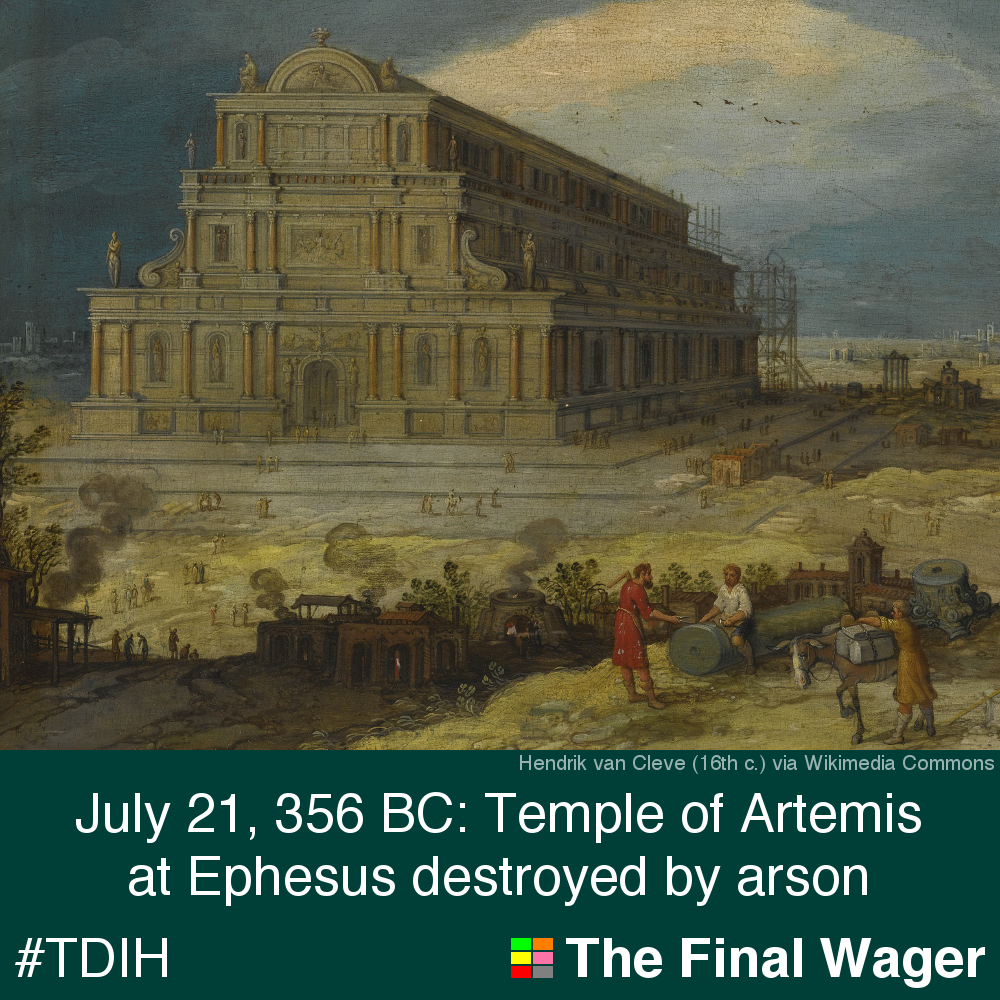
Artemis was the goddess of the hunt, equivalent to Diana in Roman mythology. Ephesus, in modern-day Turkey, was a center of her worship.
The temple destroyed in 356 BC was the second of four iterations on the site, this one built by the famously rich Croesus around 550 BC. It was burned by a man named Herostratus, who sought notoriety; his name has become obscurely synonymous with someone attempting to achieve fame at any cost. (He was executed, and his name almost entirely scrubbed from the record. Almost.)
The third temple was classified as one of Seven Wonders of the Ancient World. The list was first compiled by the historian Herodotus in the 5th century BC, based on what he had seen and heard on his travels; what we use today was from a 5th century AD writer named Philo of Byzantium (a.k.a. the Paradoxographer).
Here they are. To remember their locations, you could use the mnemonic ROBE HAG:
- The Colossus of Rhodes
- The Statue of Zeus at Olympia
- The Hanging Gardens of Babylon
- The Temple of Artemis at Ephesus
- The Mausoleum at Halicarnassus
- The Lighthouse of Alexandria
- The Pyramids at Giza
The only Wonder still extant is the oldest, the Pyramids at Giza; historians still debate whether the Hanging Gardens of Babylon existed at all.
Image: Hendrik van Cleve (c. 1525–1590/95), The Building of the Temple of Artemis at Ephesus (16th c.)
To me, the most fascinating fact about the Seven Wonders is that they were all extant together only for about 20 years (247 BC-226BC) and most were quite short lived.