
10 Oct 1957: Windscale nuclear incident
On this day in 1957, a fire broke out at the Windscale nuclear facility in northwest England, leading to the first known incident involving a nuclear reactor.
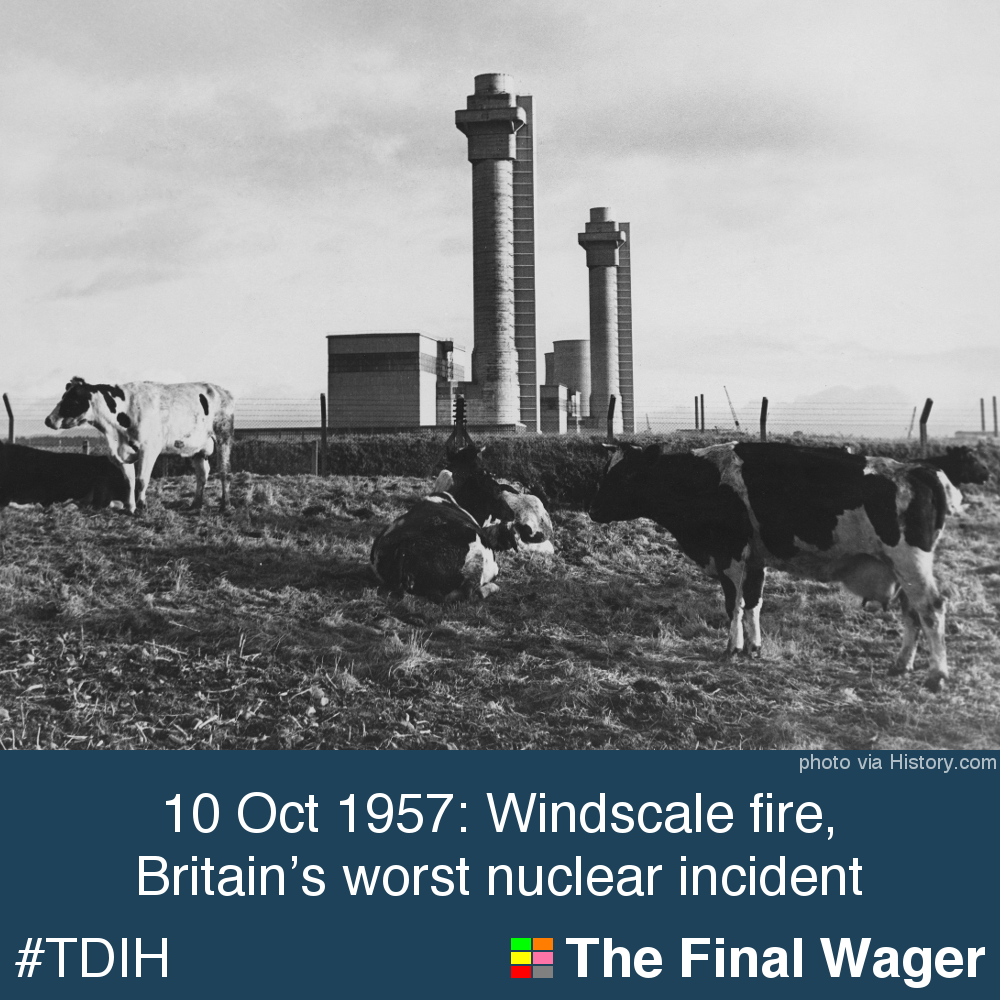
A few facts about Windscale:
- It was the first known major nuclear incident; Soviet sources later revealed that an incident had occurred at Kyshtym two weeks prior
- It was rated at Level 5 of 7 on the International Nuclear Event Scale, signifying an “accident with wider consequences,” placing it on par with Three Mile Island (1979)
- The main concern was the radioactive isotope iodine-131, which is alleged to have caused 240 cases of cancer
There have been two Level 7 events, signifying a “major accident”:
- Chernobyl, 1986: an explosion at a Russian nuclear plant resulted in 56 immediate deaths and 4,000 more from cancer; authorities evacuated over 300,000 persons and established a permanent 30 km (19 mile) exclusion zone. The reactor is now covered by a “sarcophagus” to prevent future contamination
- Fukushima Daiichi, 2011: an earthquake and tsunami affecting Japan caused several reactors to overheat, with some leakage; 300,000 persons evacuated
Image: photo of the nuclear facility
Kudos to you Keith for calling attention to this mostly forgotten but critically important event. It was, in effect, a miniature Chernobyl that happened well before Chernobyl.
The Soviet (that’s what they called themselves at the time) designers of Chernobyl (and its many siblings) were well aware that this design could have a “Windscale” type failure and that the results would be catastrophic. Their solution was an extensive system of interlocks and training of the Chernobyl operations staff designed to avoid operating the reactor in an unsafe manner. The Chernobyl staff went to a great deal of effort to use that training to defeat these interlocks. The result was a super-Windscale.
In the case of Fukushima it took a giant earthquake/tsunami to put those reactors into the danger zone. At Three Mile Island a number of seemingly insignificant design flaws and operational errors led to a failure that was a disaster in the financial sense. But despite the extensive media coverage at the time and since, it was not a public safety disaster.
Chernobyl, unlike the other two events, was a classic of a “those who fail to learn from history” event. Soviet designers tried to “learn from history” but the Chernobyl operators did the opposite.