
6 Sep 1966: Apartheid architect assassinated
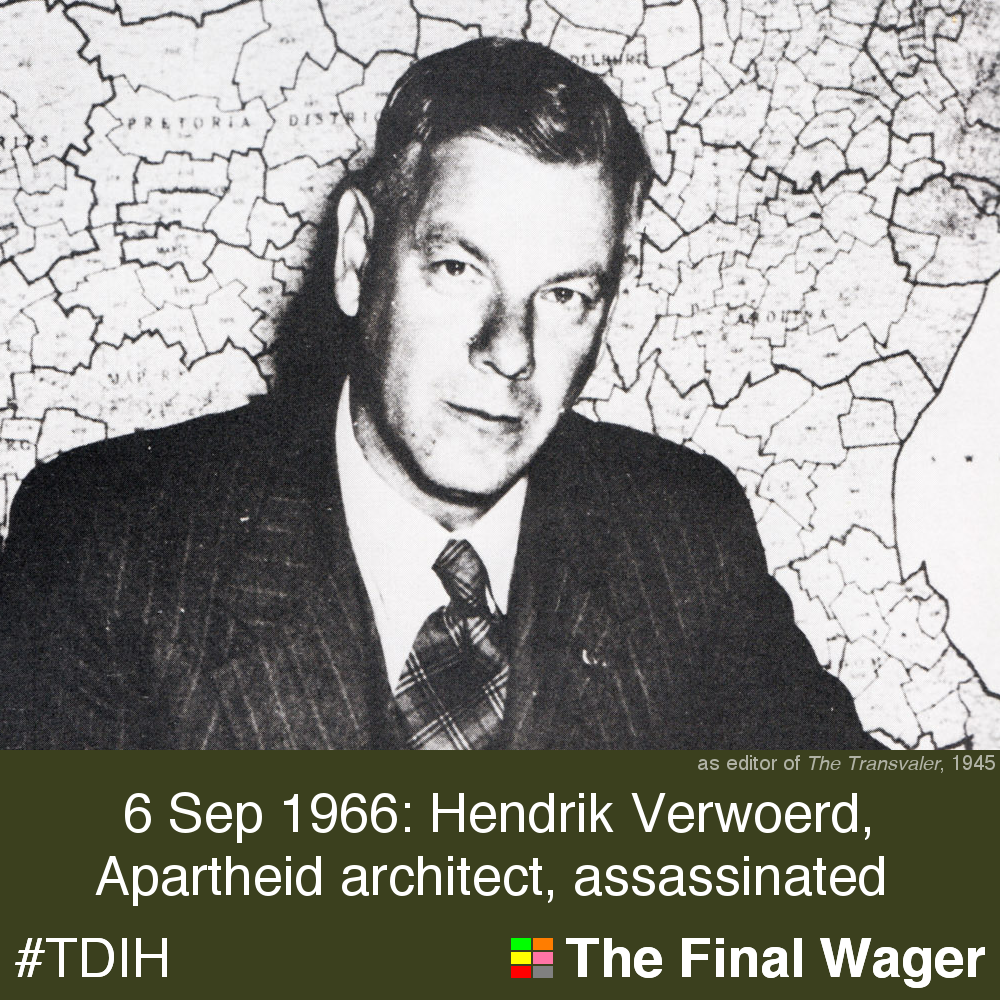
On this day in 1966, South African prime minister Hendrik Verwoerd, the architect of Apartheid, was assassinated. An official messenger stabbed Verwoerd in the neck several times as he entered the House of Assembly.
Apartheid literally means “apart-hood” and was the National Party‘s way to maintain white Afrikaner minority rule over native citizens. The NP passed laws against non-whites in a number of areas, such removing their voting rights and creating “homelands” for different ethnic groups to live.
Although a caste-style system had existed for centuries, the NP solidified it in the legal code starting in 1948. In the process, they manipulated a referendum to declare South Africa independent from Great Britain in 1961.
Verwoerd called Apartheid “a policy of good neighborliness.” The National Party fell out of power in 1994 and Verwoerd’s name has since been scrubbed from most of the places – airports, hospitals, etc. – it once (dis)graced.
Verwoerd had survived a previous assassination attempt in 1960, when he was shot twice in the head at point-blank range. This was just after the Sharpeville massacre, when 69 black South Africans were killed by police during a protest against pass laws, which required black males to carry passports wherever they went.
Note: I have always capitalized Apartheid in this context, but recognize it’s not universally accepted. Here is a good summary of the arguments for both sides.
Image: Verwoerd as editor of The Transvaler, 1945.
I think, another reason for the “a” versus “A” debate, is that “holocaust” (ie ones in addition to, but not as significant as, the Jewish one) is a word often used, as mentioned in the article, bit I’ve never seen the word “apartheid” used outside of the South African sense, yet there are historical events that could warrant it (ie a similar situation but not as signify r as the South Africans’ experience), such as the treatment of Native Americans.