
August 26, 1346: English dominate at Crécy
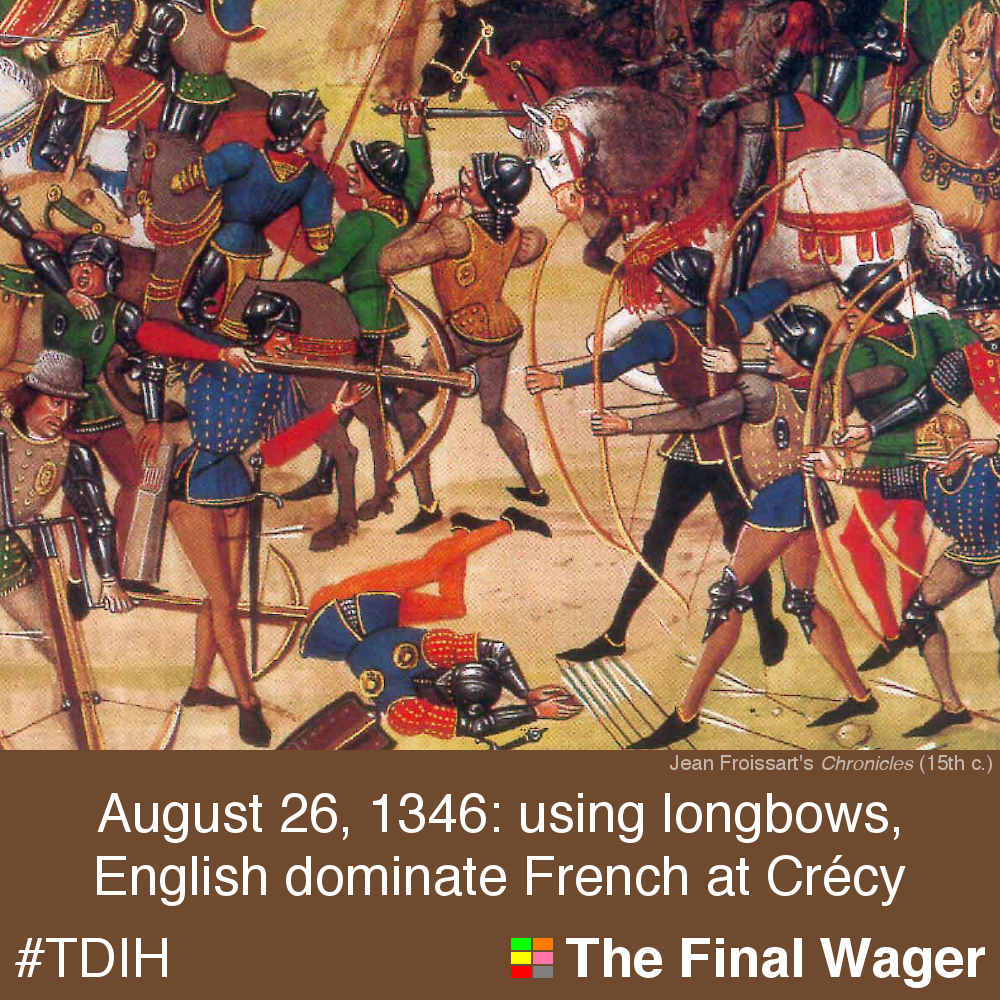
On this day in 1346, the English used a new technology – the longbow – to dominate the French at Crécy, the first large-scale battle in the Hundred Years War.
England’s Edward III had a bone to pick with his French counterpart, Philip VI. Back in 1327, when the previous king (Charles IV) died, he left no heir. Edward was his oldest closest relative, so the crown should have passed to him; the French decided that he was ineligible, however, and gave the throne to Philip, first cousin of Charles.
That was a big factor in the beginning of the Hundred Years War in 1337. (That’s a year you want to know cold.) Nine years in, Crécy was the first major battle, pitting England, Wales, and the Holy Roman Empire against France, Genoan mercenaries, and Majorca.
Although the defending French and friends had about three times as many troops (perhaps 30,000 vs. 10,000), the English had a devastating new weapon: the longbow. They were cheaper than an armored knight and could inflict serious damage before hand-to-hand combat had even begun. There is an urban legend that the French custom of cutting off opposing archers’ middle fingers, crossed with the English cry “pluck yew,” led to a certain inappropriate phrase.
There are three battles you should remember from the Hundred Years War, a fight that was very expensive, hence the need for accountants (CPAs):
Crecy (1346)
Poitiers (1356)
Agincourt (1415), perhaps most known for Henry V’s Saint Crispin’s Day speech
You should also remember the war ended in 1453, the same year Constantinople fell to the Ottoman Turks.
Image: From a illuminated manuscript of Jean Froissart’s Chronicles (15th century).