
August 9, 48 BC: Caesar routs Pompey
On this day in 48 BC, Julius Caesar defeated Pompey at the Battle of Pharsalus, leading the loser to flee to Egypt, dressed as a commoner.
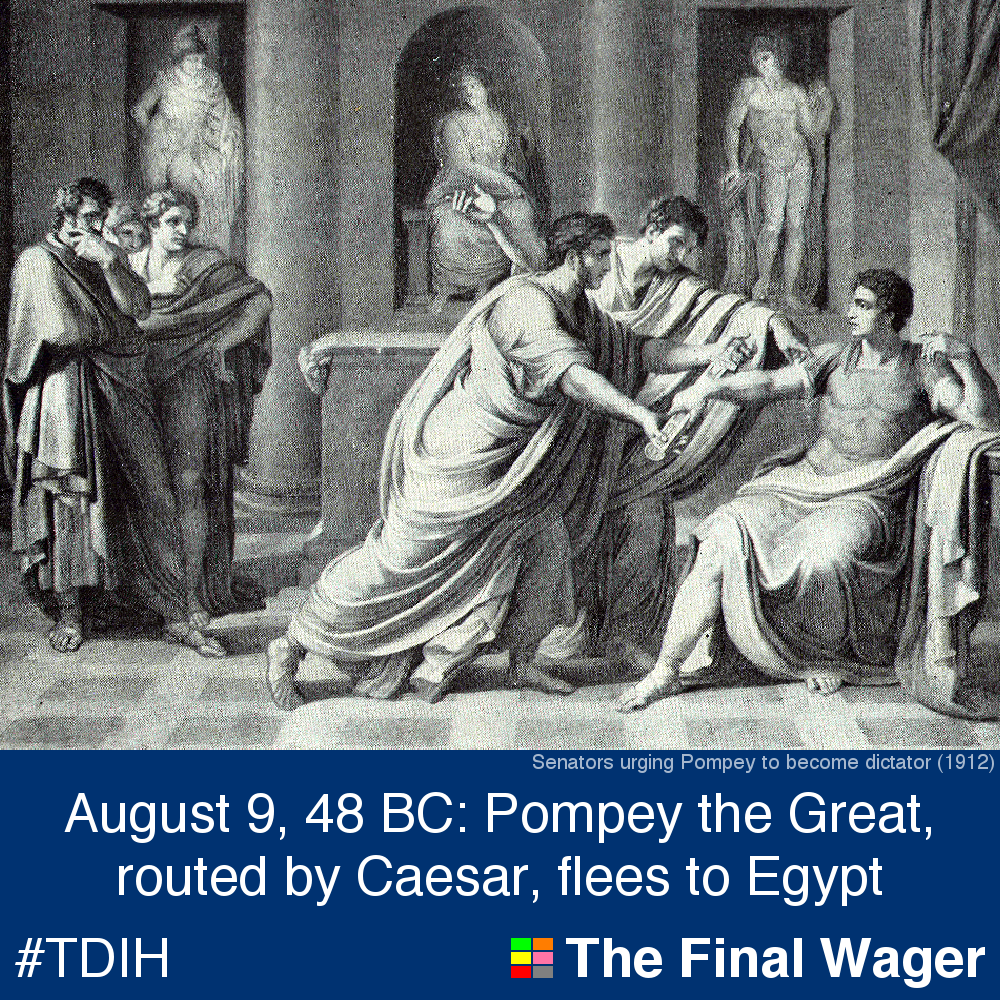
A few months after crossing the Rubicon, Caesar found himself short on men and supplies in his quest to retake Rome. For months, Pompey had stopped Caesar’s advance in Greece, and was happy to bleed his foe dry. But the Senate demanded action, and Pompey, against his better judgment, acquiesced.
The result was horrific for Pompey: he lost around 10,000 men to the few hundred alleged by Caesar. Pompey disguised himself as a commoner and escaped to Egypt; Caesar would follow him and have him assassinated in September. Although the battle did not end the civil war, it proved to be the turning point, and some scholars consider it the end of the Roman Republic.
Pompey and Caesar, along with Crassus, had composed the First Triumvirate, which ruled from 59-53 B.C. The Second Triumvirate, formed in 43 B.C. after Caesar’s death and lasting for ten years, consisted of Octavius (later Augustus, the first Roman emperor), Marc Antony, and Lepidus.
Image: Senators urging Pompey to name himself Roman dictator. From The Story of Rome by Mary McGregor (1912).