
August 7, 1947: Kon-Tiki reaches its goal
On this day in 1947, Norwegian explorer Thor Heyerdahl reached French Polynesia in his boat Kon-Tiki, built from materials that would have been available to South Americans in pre-Columbian times.
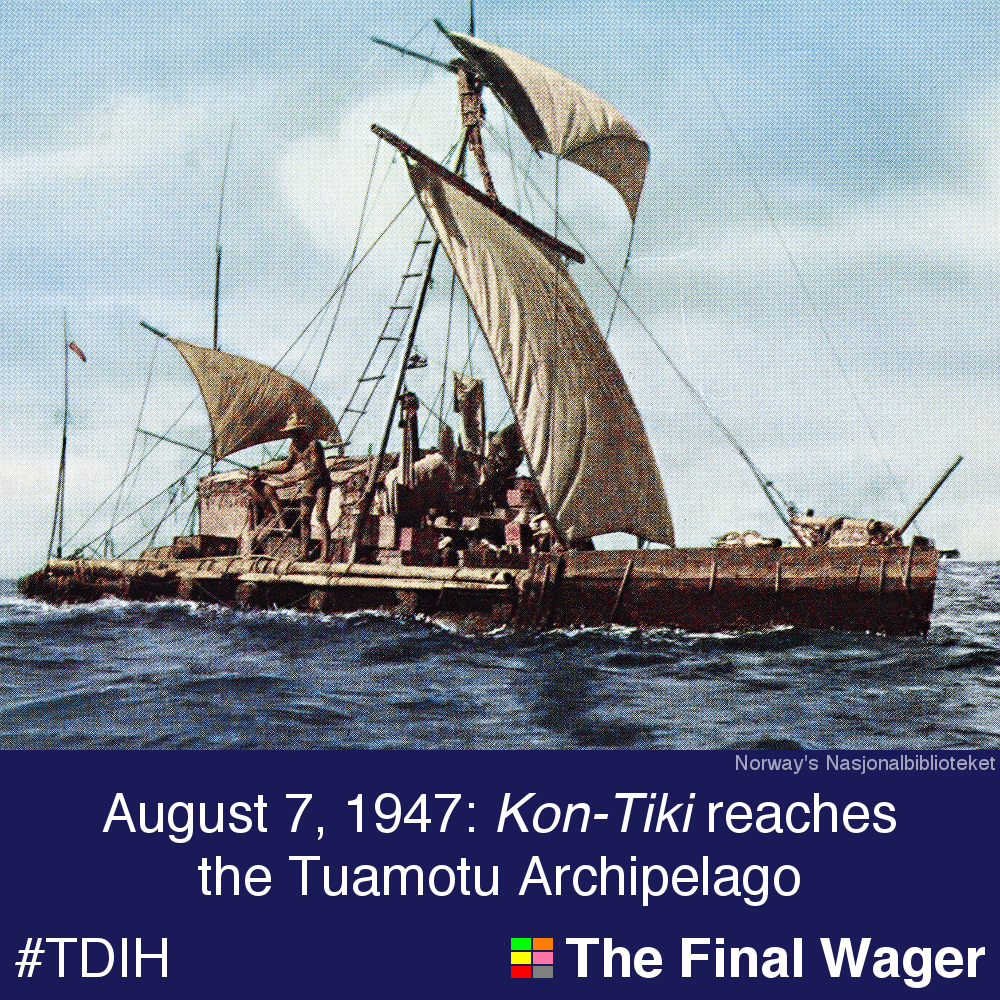
Heyerdahl had a theory that South Americans had sailed west to populate the islands of the Pacific. He built a balsa-wood raft based on drawings of indigenous vessels drawn by Spanish conquistadors, and chose the name Kon-Tiki, the Incan sun god.
After 101 days and over 4,000 miles, Heyerdahl and his five companions crashed on a reef near Raro-nuku, an atoll in French Polynesia.
Heyerdahl’s westbound theory has since largely been dismissed, particularly after the 1976 voyage of Pius “Mau” Piailug, who sailed without instruments from Micronesia to Hawaii in the Hōkūleʻa.
Image: Postcard from 1947: “Expedition Kon-Tiki 1947. Across the Pacific.” Nasjonalbiblioteket / National Library of Norway.