
August 1, 1774: Priestley discovers oxygen
On this day in 1774, British scientist Joseph Priestley discovered oxygen – a claim that could also be made by two other men.
Like most enlightened thinkers of the 18th century, Priestley could describe himself in several ways: theologian, chemist, philosopher, political scientist.
The concept of oxygen revolved around flames. Many scientists believed that when a candle burned, it gave off a material called phlogiston; the reason a candle enclosed in a bulb would go out was the surrounding air had too much phlogiston, and could not take any more. (Of course, it’s because the flame has run out of oxygen.)
Although Priestley is often credited with discovering this new type of “air”, German-Swede Wilhelm Scheele made a similar discovery in 1771, although Priestley beat him to publishing; Frenchman Antoine Lavoisier recognized that the new “air” was actually a new element, and he named it in 1777.
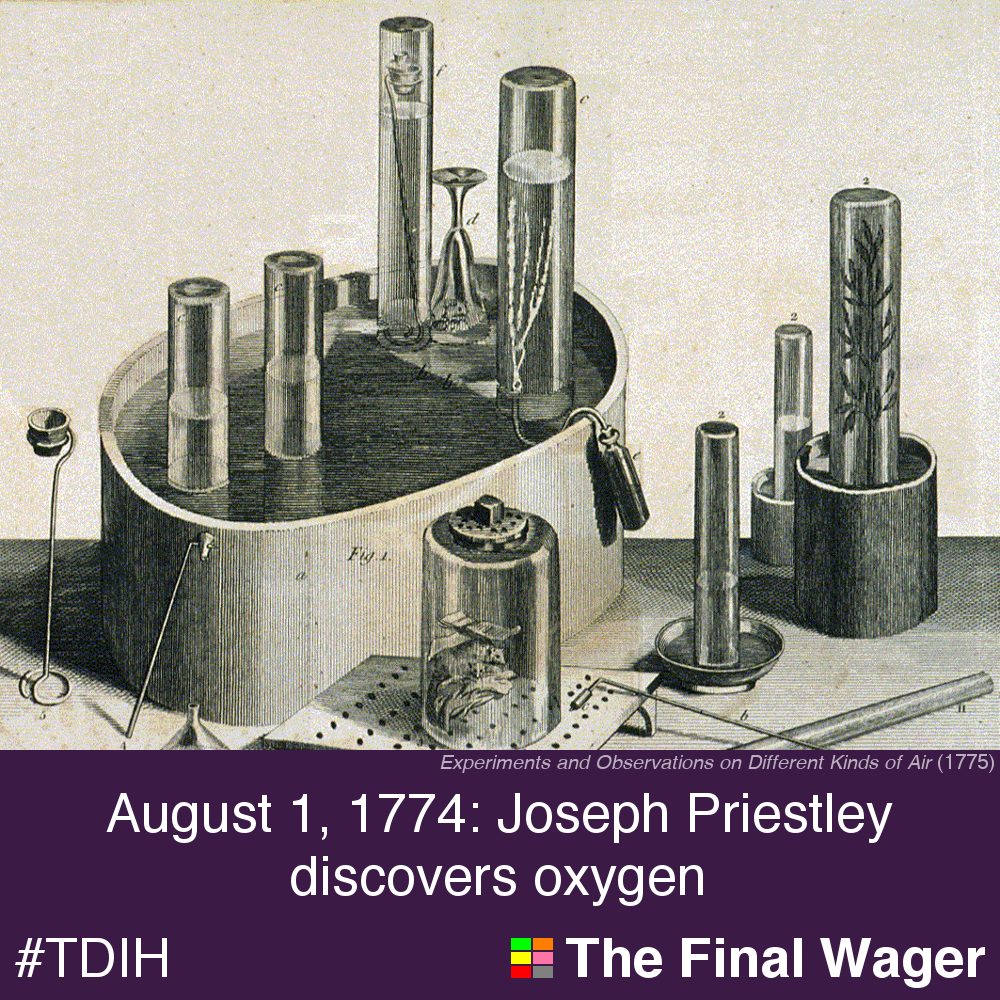
Image: Pneumatic trough, and other equipment, used by Joseph Priestley. From Experiments and Observations on Different Kinds of Air (1775).