
June 19, 1865: first “Juneteenth” celebrations
“The people of Texas are informed that in accordance with a Proclamation from the Executive of the United States, all slaves are free. This involves an absolute equality of rights and rights of property between former masters and slaves, and the connection heretofore existing between them becomes that between employer and free laborer.”
On this day in 1865, Major General Gordon Granger read the above words, known as General Order 3, to a crowd in Galveston, Texas – including slaves who were unaware the Emanciptation Proclamation had been issued 2 1/2 years prior.
The date has since been known as Juneteenth.
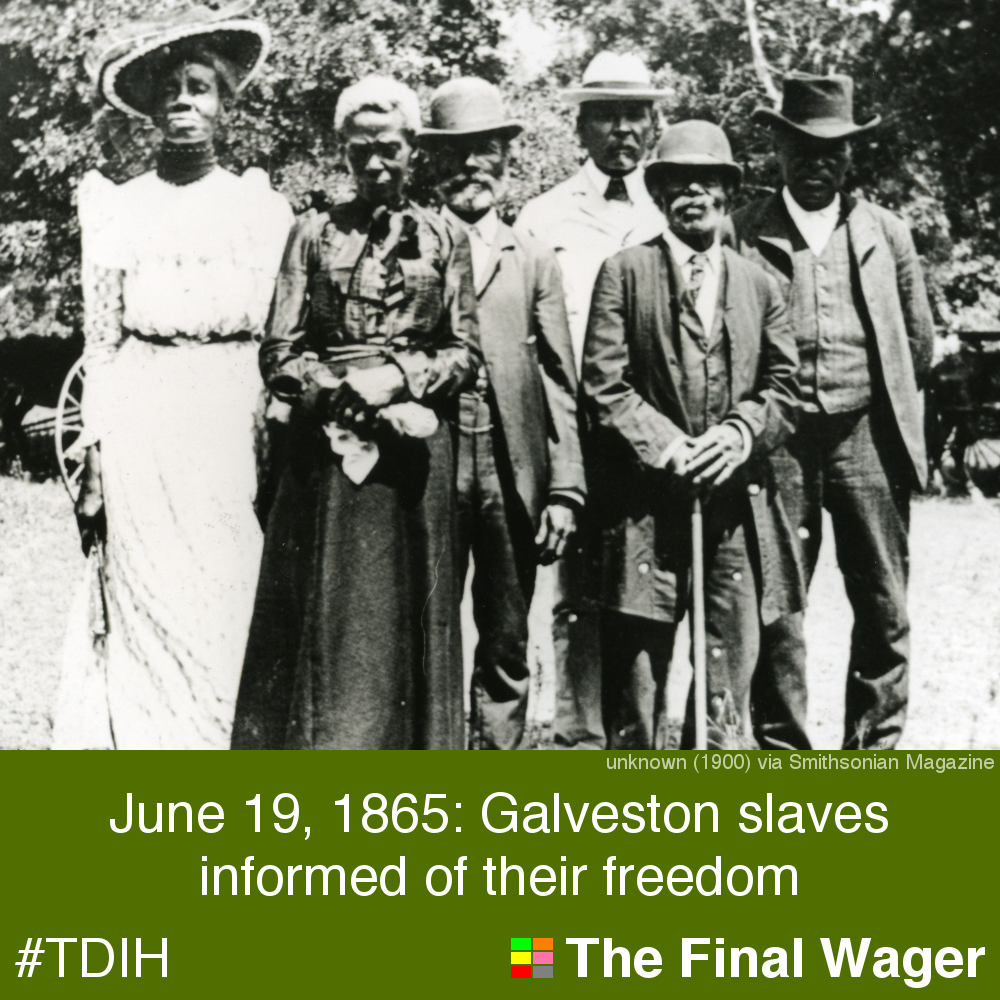
Slaves in rebelling states were technically free as of January 1, 1863, but even if the Confederacy did acknowledge Abraham Lincoln’s authority (yeah, right), there was no way for the Union to enforce the order.
Juneteenth is recognized in 42 states. Celebrants dress in their finest attire, gather around a barbecue pit, and eat and drink special foods (strawberry soda is synonymous with the day). Many make a pilgrimage to Galveston.
For more, visit Juneteenth.com. Image: “Official Juneteenth Committee, East Woods Park, Austin, Texas, June 19, 1900” via Smithsonian Magazine
N.B. #1 – It pains me to post this just two days after what happened in Columbia, South Carolina. That massacre – perhaps act of terrorism is more appropriate – is a reminder that 150 years after the end of the Civil War, our country still has serious problems with race. Unfortunately, many politicians on one side of the aisle prefer to call this an unavoidable, isolated act rather than address the systemic issues.
N.B. #2 – The “Emanciptation” spelling was intentional.
The biggest “systemic issue” being that deliberate fight-provokers like Al Sharpton are now setting the government’s agenda about race, keeping race an issue when to most of us it isn’t one.