
June 1, 1660: Quaker Mary Dyer hanged
On this day in 1660, Mary Dyer was hanged in Boston for the crime of being a Quaker. Her execution led to sweeping changes in the Massachusetts Bay Colony.
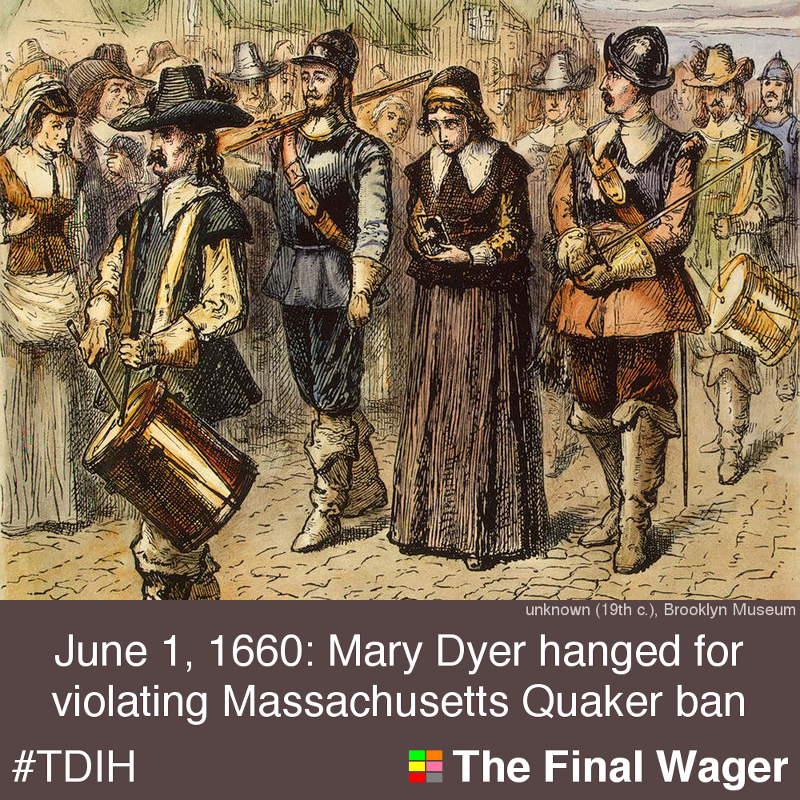
The 24-year-old Dyer arrived in Boston with her husband, William, in 1635. The two Puritans soon established themselves as supporters of Anne Hutchinson and John Wheelwright in the Antinomian Controversy. Disenfranchised, the pair left to join Roger Williams in Rhode Island.
Before they left, though, Mary had given birth to a stillborn, mutilated child, which they buried in secret; when Massachusetts authorities found out about the episode, they said it was proof that her beliefs were incorrect.
Mary returned to England in 1651, where she converted to Quakerism. By the time she came back to Boston in 1657, Puritans had passed laws banning the religion, and she was immediately thrown in jail. She fought the charges, and refused to be exiled, which led to a first attempt at hanging in 1659 (she was granted a reprieve on the gallows) and, after she still insisted on becoming a martyr, in 1660.
She was the third Quaker to be executed, joining Marmaduke Stephenson and William Robinson. Dyer’s death was the last straw for King Charles II: upon learning of it, he forbade Massachusetts from executing Quakers – Friend William Leddra of Barbados would become the fourth martyr before the ruling was received – and England eventually took over governance of the colony.
Mary Dyer has an entire blog dedicated to her.
Image: Unknown artist. Mary Dyer Led to Execution on Boston Common, 1 June 1660, 19th century. The Granger Collection, New York (Brooklyn Museum).
Hence, the term “dyer straits”.