
May 21, 293: Rome institutes “rule by four”
Consider the Norman conquest of 1066, when William the Bastard defeated King Harold II at Hastings. There’s an often-overlooked reason for the home team’s loss: they had just rushed back from the north of England.
Although Harold had roundly defeated Harald Hardrada’s Vikings at Stamford Bridge, the kingdom was no longer his, due to the tired state of his army. And England was a tiny place. Imagine the issues territory the size of, oh, say, the Roman Empire would present.
On this day in 293, faced with a similar situation, the ruling Roman co-emperors added two more, instituting the period now known as the Tetrarchy – rule by four.
An emperor – the commander in chief – couldn’t be in two places at once, so if Gauls attacked the western frontier while Ostrogoths invaded from the east, there’d be a problem.
Diocletian was aware of this when he ascended in 284. With the Crisis of the Third Century still fresh, and minor rebellions happening in all corners of the empire, he named the general Maximian Caesar (junior emperor) in 285, and Augustus in 286. Diocletian oversaw the eastern half of the empire, although this was not a formal division.
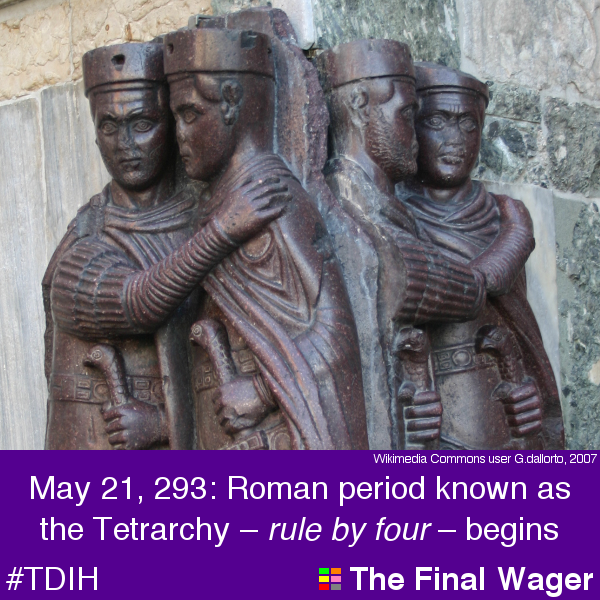
The pair split their duties even further in 293, each taking on a Caesar to help out: Galerius and Constantius Chlorus. The quartet was careful to maintain the image of patrimonium indivisum – an indivisible empire – with images as the above, which now adorns a corner of Saint Mark’s Basilica in Venice. Note how the rulers are close together, wearing the same attire.
Diocletian and Maximian both resigned in 305, and the Caesars became the new Augusti with new Caesars. Internal strife soon followed, of course, and by 313, Constantine the Great had consolidated most of the empire’s power in his hands.
Note: the term Tetrarchy was not used for this time period until the late 19th century, although Romans had used it for other ruling foursomes.
For more on the Tetrarchy, visit UChicago’s Encyclopædia Romana.
Image: Giovanni Dall’Orto, August 12, 2007, as uploaded to Wikimedia Commons.