
April 17, 1397: Canterbury Tales debut
On December 29, 1170, Thomas Becket, the archbishop of Canterbury, was murdered on his altar by knights sent by King Henry II. (The year 1170 is a good one for Jeopardy! contestants to know.)
More than two centuries later – and 618 years ago today – the most influential work surrounding this event was first told to the court of King Richard II.
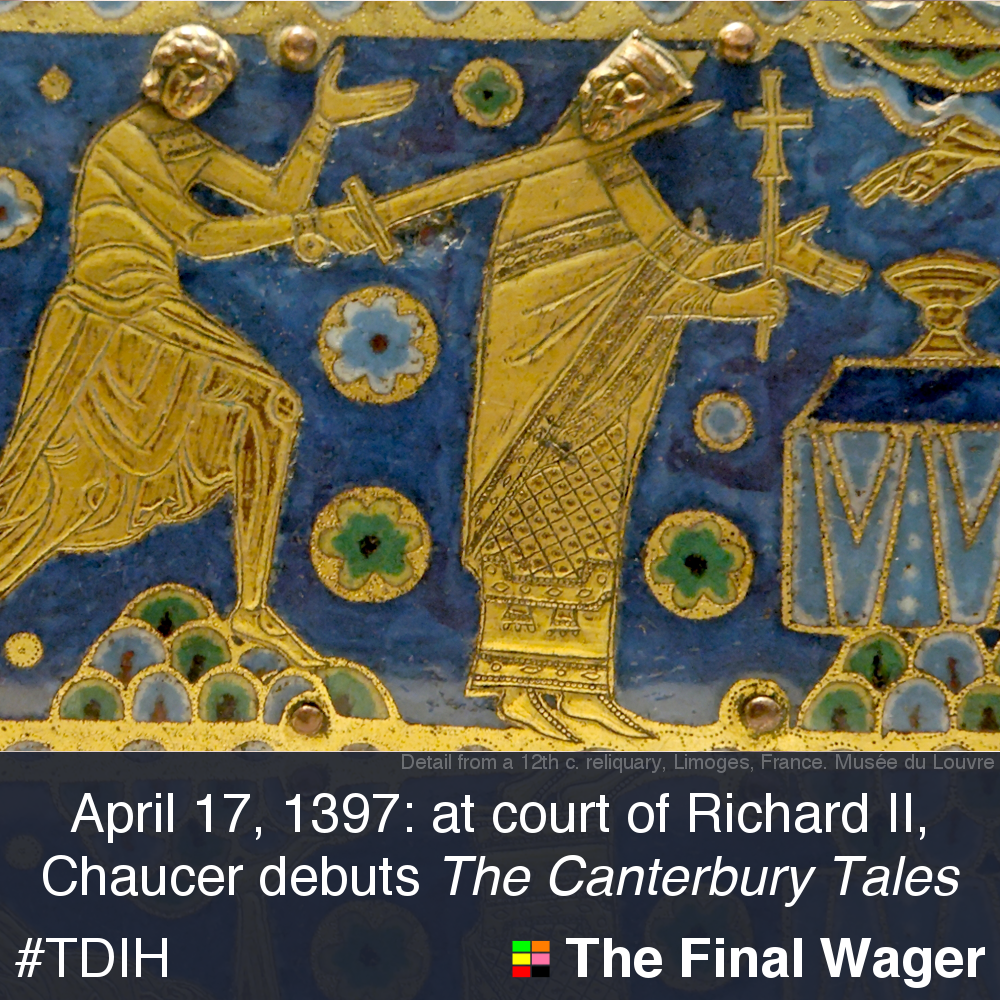
The Canterbury Tales, the magnum opus of Sir Geoffrey Chaucer, concerns 30 pilgrims from Southwark traveling to the site of Saint Thomas’s martyrdom. To pass the time on their journey, they tell stories; the traveler who spun the best tale was to receive a free meal at the Tabard Inn upon his return.
Probably inspired by Boccaccio’s Decameron, in which ten characters each tell ten stories over ten days, The Canterbury Tales was to have four stories from each character, for a total of 120. How many Chaucer actually completed is unknown; 24 tales and an introduction exist today, derived from 83 handwritten manuscripts.
My personal favorite is “The Miller’s Tale”, which is incredibly lewd for the time period; it includes adultery and one man farting in another’s face.
The work is notable for its composition in Middle English, as opposed to the more “learned” languages of Latin and French.
For more, including full texts in Middle and modern English, visit Librarius.