
Wagering practice – how to show restraint
This is from David Menchaca’s second game in Season 28. What would you do as Jim, who’s in third here?

Click here for the answers!
(Thanks to the J! Archive)
Answers to Friday’s scenario:
(click to view as a slideshow)
I see four “decent” wagers for Hillary with the Daily Double to enter a wager-to-tie situation. If she’s confident, she might wager 4,000 or 2,400 and hope she gets an easy clue; if she’s not, she could try to “toss” 1,400 or 4,200.
I think 2,400 is her best wager. If she’s right, she’s in second place; if she’s wrong, she still forces second to wager to beat her.
-
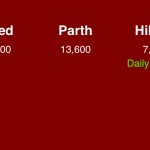
- Hillary’s got the Daily Double on the last clue of Double Jeopardy!. How can she maximize her chances?
-
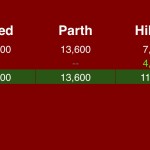
- Option 1: wager 4,000 and get it right.
-

- That way, she’ll be in second place with evenly-spaced scores
-
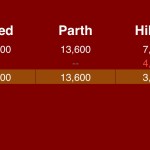
- She risks a far tumble with an incorrect response, though.
-
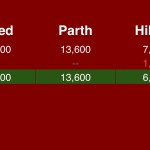
- Option 2: wager 1,400 and answer incorrectly.
-
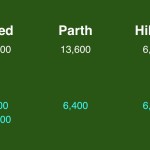
- She’ll then be in an evenly-spaced situation, but still in need of some help (since she’s in third).
-
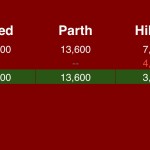
- Option 3: Dump 4,200.
-
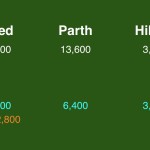
- In that case, first = second + third. She still needs some help.
-
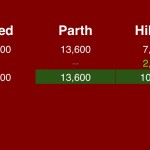
- Option 4: 2,400 and aim to get it right.
-
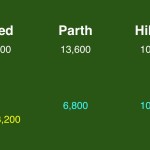
- In this case, she’ll have exactly 3/4 of Parth’s score, and Parth should wager for the tie.
-
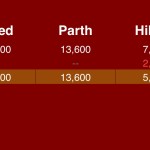
- If she’s wrong, though, she’s in distant third – but not out of it.
This is actually a fairly straightforward scenario – from Jim’s position unless I had reason to think that one or both of my opponents would bet “small” I’d probably wager no more than $1,400 to beat both of them should they make the bet to cover and miss. This logic applies whenever 3rd is within 2/3 of 2nd (and thus can wager to beat 2nd’s cover bet on a double miss) and has at least twice the difference between 1st and 2nd’s score (and thus can beat 1st’s cover bet if they both miss).