
3 Oct 52 B.C.: Vercingetorix surrenders Gaul
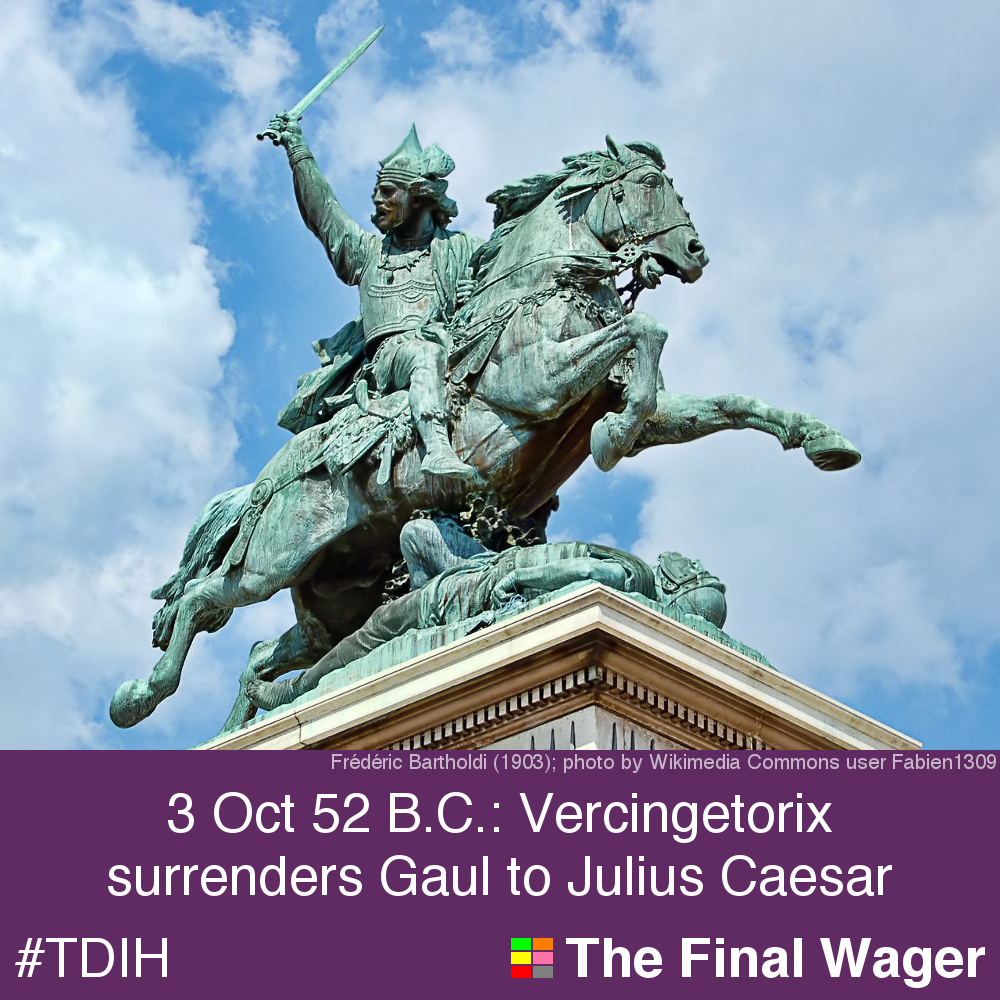
On this day in 52 B.C., Vercingetorix surrendered to Julius Caesar after the Battle of Alesia, effectively ending the Gallic Wars.
He was held prisoner at the Tullianum (now known as the Mamertine Prison) in Rome, which would later play host to Saints Peter and Paul, according to legend.
In 46 B.C., he was paraded through the streets of Rome in Caesar’s triumphant homecoming; afterwards, he was strangled to death.
Vercingetorix is a cool Latin name, which is part of the reason I picked today’s entry. I also thought it would give me an excuse to list some other Latin terms for modern-day areas:
- Hispania: Iberian peninsula
- Lusitania: Portugal
- Lutetia: Paris
- Brittania: the island of Great Britain
- Hibernia: Ireland
- Germania: Germany
- Dacia: central Europe, mostly Romania and Moldova
- Dalmatia: much of the area north of the Adriatic Sea
- Pontus Euxinus: Black Sea
Image: equestrian statue by Frédéric Bartholdi (1903); photo by Wikimedia Commons user Fabien1309
“Germania” (literally, the domain of vulgar languages) was a general term covering everything east of the Rhine and north of the Danube. There wouldn’t be any such thing as a nation you could call Germany until the reign of Karl der Große (Charlemagne) in the 8th century.