
16 Sep 1810: Hidalgo calls for independence
On this day in 1810, Miguel Hidalgo uttered the famous “Cry of Dolores” (El Grito de Dolores), calling for Mexican independence from Spain. The date is now celebrated annually as Mexican Independence Day.
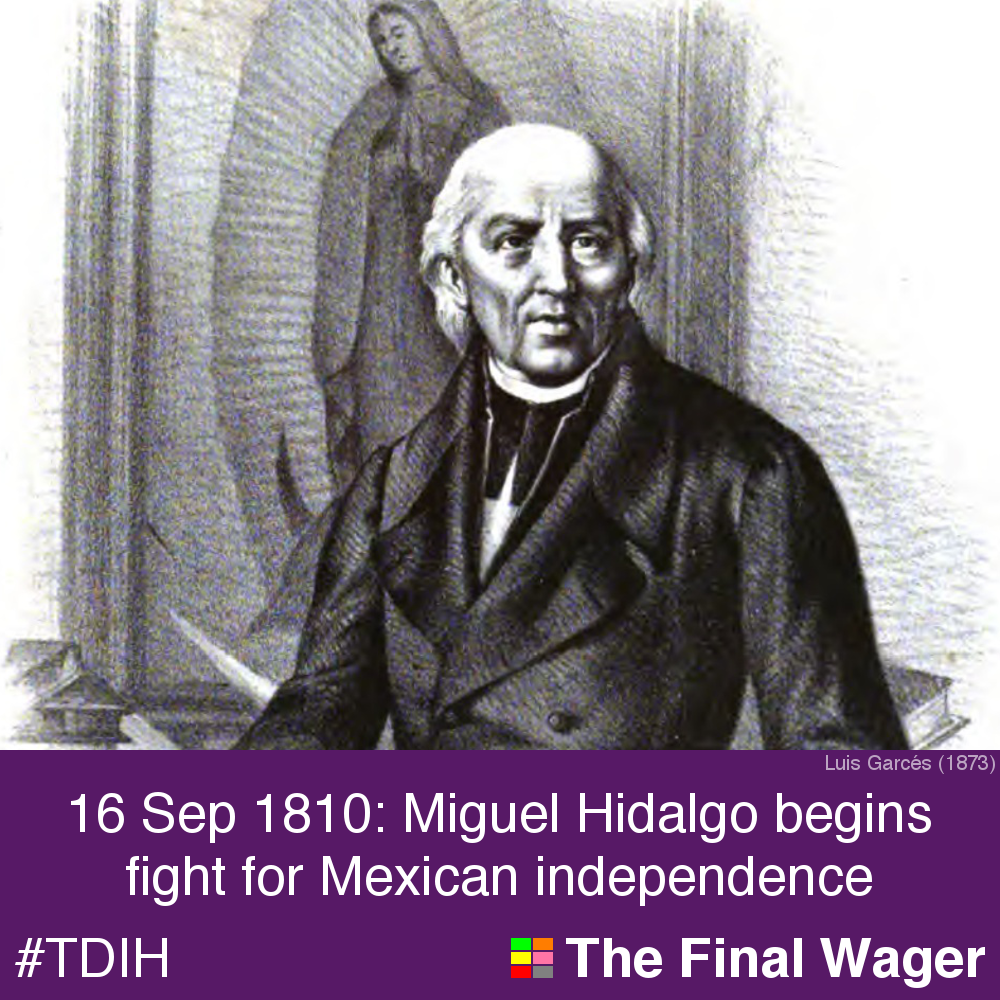
Hidalgo was a Catholic priest in the town of Dolores (hence, the name of the speech). He had gripes against the Spanish government: Spain placed restrictions on the growing of grapes and olives, two crops that were most easily grown by the poorer members of his flock.
No authoritative text of the speech exists, although it’s generally agreed that either Hidalgo or the crowd – or both – shouted: “Death to bad government! Death to the gachupines!” (A gachupín was a Spanish settler in Mexico.)
Hidalgo was betrayed and turned over to the Spanish, who executed him by firing squad on July 30, 1811. They displaced his head at one corner of a granary in Guanajuato, with the heads of three other revolutionaries at the other three corners:
- Juan Aldama
- Ignacio Allende
- José Mariano Jiménez
Independence for Mexico finally came on September 28, 1821 – more than eleven years after Hidalgo’s grito. Hidalgo is today referred to as the “father of Mexico.”
Image: Luis Garcés (1873). In the background is Our Lady of Guadalupe, whom Hidalgo had adopted as his standard.