
August 11, 1919: Weimar Republic established
On this day in 1919, the Weimar Republic adopted its constitution, assuming the name Deutsches Reich – the German Reich. It did so in the town of Weimar, lending the republic its more common name.
For most of its 14 years, the Weimar Republic was perhaps best known for its hyperinflation; some people burned paper money for heat because it was cheaper than buying wood. However, Germany was able to get out of several provisions from the Treaty of Versailles, including the bulk of its reparations.
The Republic effectively ended on March 24, 1933, when a constitutional amendment known as the Enabling Act allowed the chancellor (the newly minted Adolf Hitler) to pass laws without support of the legislature. (A Final Jeopardy! clue relating to this from early this season took a good angle.)
Its first president was Freidrich Ebert, and Philipp Scheidemann was its first chancellor. Paul von Hindenburg was president from 1925 until the Republic’s end.
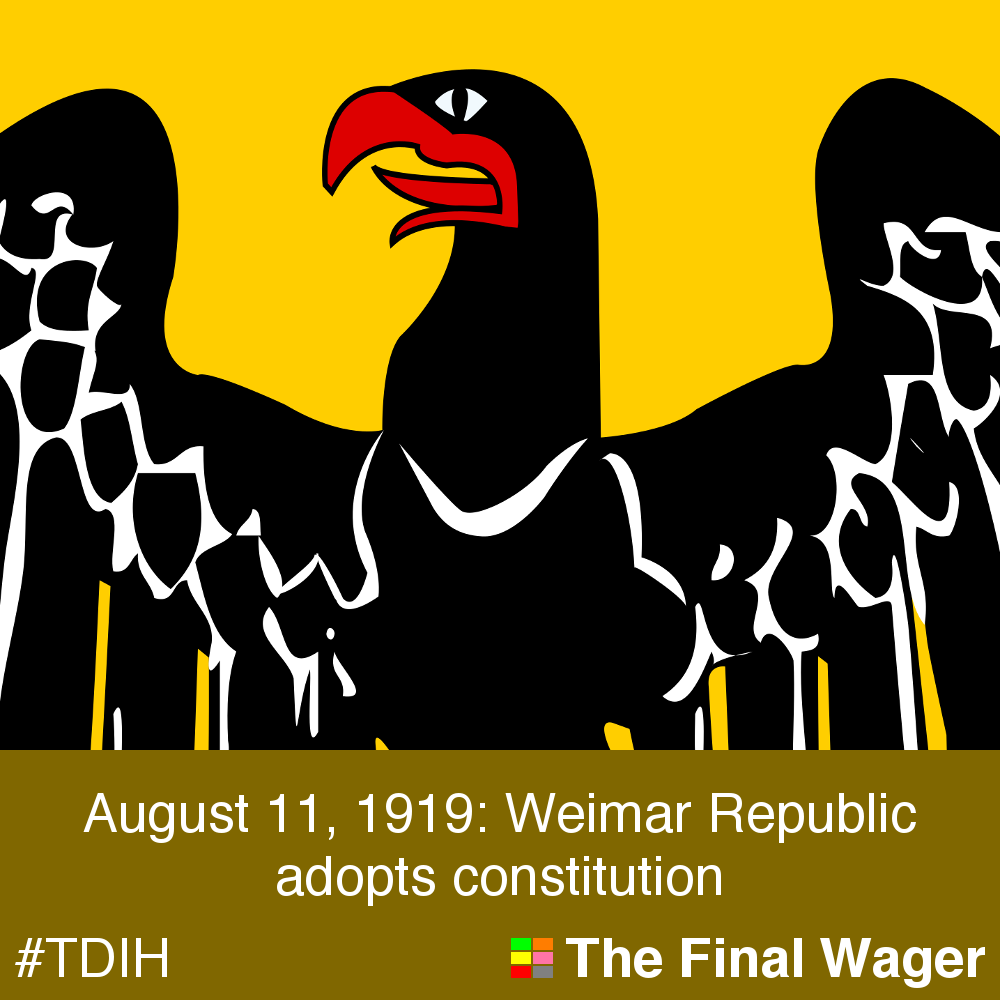
Image: Karl-Tobias Schwab (1887–1967), coat of arms of the Weimar Republic, 1928-1933. Used for the Federal Republic of Germany from 1950.