
July 27, 1921: insulin-glucose link discovered
On this day in 1921, two researchers working at the University of Toronto isolated insulin – and began thinking of ways it could be used to regulate blood sugar.
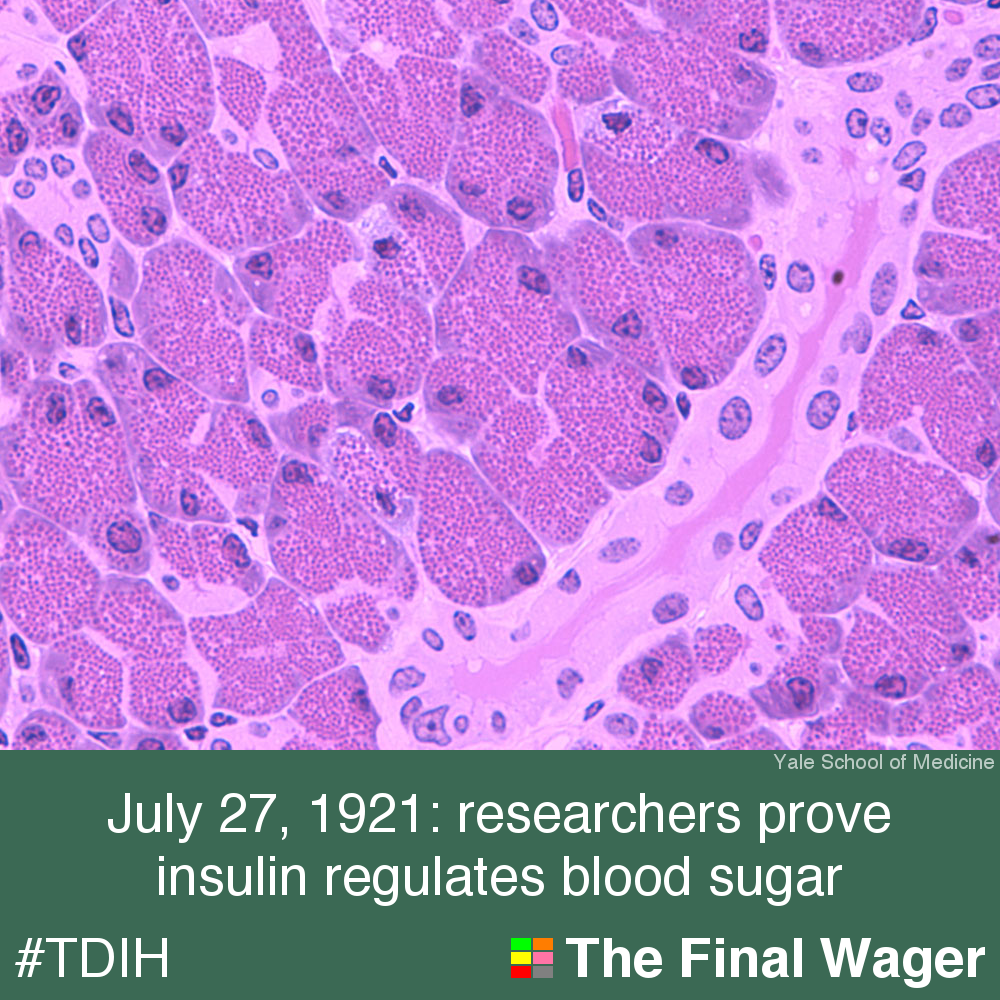
Insulin is produced by the islets of Langerhans, small structures in the pancreas named for Paul Langerhans, who discovered them in 1869.
In 1889, Oskar Minkowski removed the pancreas of a dog; a few days later, flies were attracted to its urine due to the presence of sugar. Eugene Lindsay Opie, in 1901, further isolated sugar collection to the islets of Langerhans, but the magical compound within was quickly broken down by the rest of the pancreas.
In 1920, Frederick Banting, a Canadian surgeon, had an idea: maybe he could kill most of the pancreas while keeping the islets intact. He convinced a professor in Toronto, J.J.R. Macleod, to lend him a lab for the following summer, along with some dogs for testing and a research assistant named Charles Best.
The experiments were successful, and the first human insulin injection was given to Leonard Thompson, a dying 14-year-old, at a Toronto hospital on January 11, 1922. Thompson lived 13 years longer before dying of pneumonia, by which time Banting and Macleod had shared the Nobel Prize.
Banting and Best were unable to isolate completely pure insulin, so they contracted with Eli Lilly and Company, who soon achieved the feat in large quantities. Today, most insulin is synthetic, the first example of which was Humulin in 1982.
Image: pancreas cells, Yale School of Medicine