
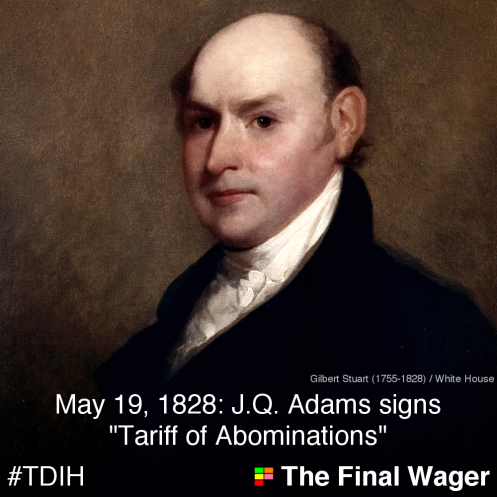
May 19, 1828: J.Q. Adams signs ‘abomination’
The North had been the main beneficiary of the Industrial Revolution, setting up factories to produce all varieties of goods. The South, on the other hand, remained mostly agricultural.
On this day in 1828, to protect American manufacturing, President John Quincy Adams enacted a tariff on imported cloth and other items. This angered the South; the North could produce its own fabrics, and British textile-makers would purchase less cotton.
Ultimately, South Carolina would insist it had a right to nullify federal laws, setting up a constitutional confrontation.
As anger built south of the Mason-Dixon, Vice President John C. Calhoun, a South Carolinian, came to a questionable conclusion: since the federal government derived its power from the individual states, any individual state should be able to nullify a federal law.
When his home state followed through on this idea, formally rejecting the tariff in 1832, the country teetered on the brink of disunion. If a state could ignore a federal law, what was the point of having a federal government?
Although he was also a Southerner, President Andrew Jackson wouldn’t tolerate this challenge to the nation’s structure. He convinced Congress to pass the Force Bill, allowing him to use federal troops to force compliance of the tariff. A compromise was reached in Congress in 1833, and the inevitable war between the states was further delayed.
Even though the Supreme Court finally put the theory of nullification to bed in Cooper v. Aaron (1958), several Tea Party legislators in recent years have tried to bring it back. You know what they say about those who don’t learn history…
For more on the nullification crisis, visit USHistory.org.