
May 17, 1990: homosexuality no longer ‘abnormal’
As we await the decision of the U.S. Supreme Court as to whether same-sex couples have the right to marriage, here’s a reminder that what we call “history” doesn’t need to be ancient.
On this day in 1990, the World Health Organization removed “homosexuality” from its list of psychiatric disorders. (That’s just 25 years ago.)
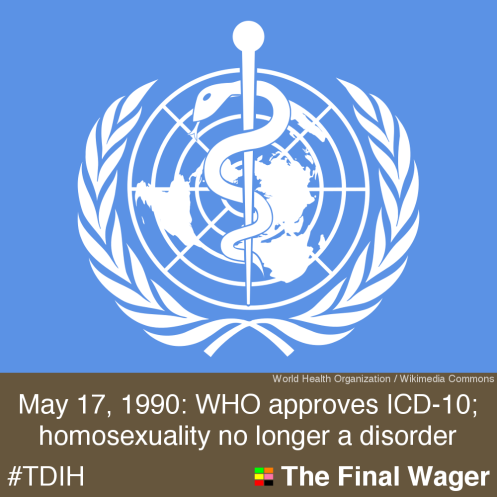
The WHO publishes the International Classification of Diseases (ICD), the worldwide standard for diagnosing and recording diseases. Its ninth edition, approved in 1978, had “sexual deviations and disorders” as code 302, with the following as its first subsection:
302.0 Homosexuality
Exclusive or predominant sexual attraction for persons of the same sex with or
without physical relationship. Code homosexuality here whether or not it is
considered as a mental disorder.
When the WHO approved ICD-10 in 1990, it totally revamped the codes; what used to be 302.0 is now best placed under F66, ego dystonic sexual orientation. The Centers for Disease Control (CDC) began using its own modified guide, known as ICD-9-CM, in 1996, replacing homosexuality with that same term, still under code 302.0 (which recently caused issues for at least one doctor).
The American Psychological Association, it’s worth noting, had removed homosexuality from its Diagnostic Standards Manual (DSM) by 1973.
In 2000, my home state of Vermont became the first to enact legislation allowing civil unions of same-sex couples. Just fifteen years later, 37 states and D.C. allow marriage (Vermont upgraded in 2009), and the Supreme Court will soon rule, in Obergefell v. Hodges, whether that right should be extended nation-wide, with states required to acknowledge same-sex marriages from other states.
Nearly 20 countries, along with individual states of a few others, have also come to recognize same-sex marriage within that timeframe. Big-time social change at warp speed.
For more on the history of same-sex marriage before the present day, check out this academic paper from 1993.