
May 16, 1868: Senator Ross takes a stand
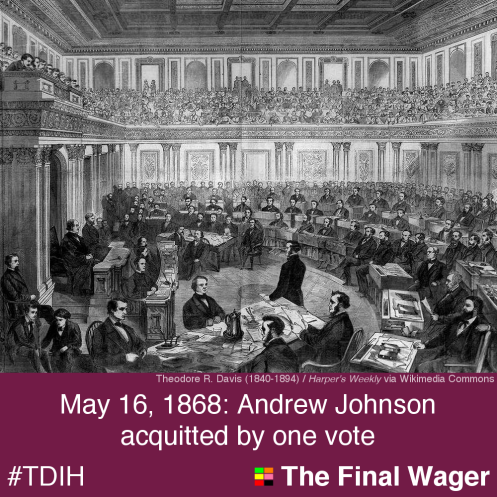
On this day in 1868, Senator Edmund G. Ross cast the deciding vote to acquit President Andrew Johnson of charges for which he had been impeached.
The election of 1864 was an odd one: the incumbent, Abraham Lincoln, had ditched his Republican mantle and his Vice President (Hannibal Hamlin) to form the Union Party. He pulled in a Democrat from Tennessee, Andrew Johnson, and won re-election handily.
Six weeks after inauguration, events at the most famous showing of My American Cousin thrust Johnson into the top position. As the wounds of the Civil War began to heal, Johnson showed a much softer position toward the South than so-called Radical Republicans wanted.
One of those Republicans, Edwin G. Stanton, was still the Secretary of War. (When the President breathed his last, Stanton, at bedside, allegedly muttered, “Now he belongs to the ages.”) Johnson found Stanton’s approach too heavy-handed, and sought to have him removed in 1867.
In response, the heavily Republican Congress passed the Tenure of Office Act, requiring the president to obtain Senate approval for removals from Cabinet positions. (The same was already necessary for appointments, but that one’s in the Constitution proper.)
After the Senate rejected one Johnson attempt to oust Stanton, the beleaguered president tried again, and was met with an impeachment from the House. The case was tried in the Senate, where it quickly became obvious that 35 were in favor, 18 were opposed. One man would decide whether the two-thirds requirement for removal was reached: Edmund G. Ross, a Republican from Kansas.
Had Ross gone along with his party, under the succession rules in place at the time, Senate president pro tempore Benjamin Wade would have ascended to the presidency. For one thing, this could have caused a Constitutional crisis at a time of great strain in the split nation.
Ross was enshrined in John F. Kennedy’s book Profiles in Courage as a moralistic hero, but there’s significant evidence that he voted with Johnson as a bargaining chip, and that other senators were prepared to do the same. You can read about that in this Slate article by David Greenberg published around the time Bill Clinton became the second president impeached.
Ross would lose his re-election campaign, although he was appointed Governor of the New Mexico Territory in 1885.