
May 4, 1886: Haymarket Riots in Chicago
“The day will come when our silence will be more powerful than the voices you are throttling today.”
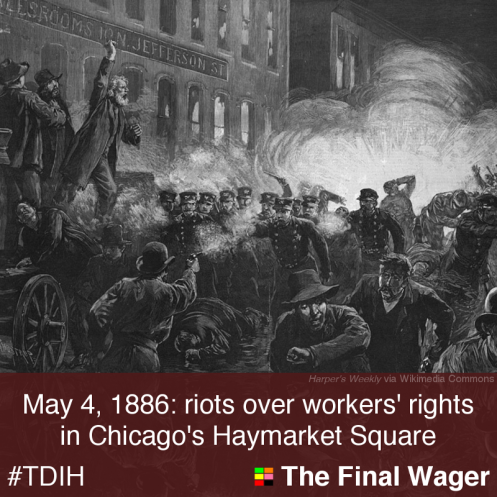
So said labor organizer August Spies from the gallows, soon to be hanged for his role in the Haymarket Affair, which took place in Chicago on this day in 1886.
Chicago was the center of the “eight-hour” labor movement. In 1884, the predecessor of the American Federation of Labor (AFL) named May 1, 1886 as the deadline for general acceptance of this figure. Many unions had already been striking for months leading up to that date.
“Eight hours a day, no cut in pay,” chanted between 30,000 and 80,000 workers as they marched down Michigan Avenue on May 1. The event was peaceful, but a follow-up on May 3, outside the McCormick Harvesting Machine Company, turned deadly when police opened fire on a group of striking workers, killing two.
On May 4, labor leaders – who tended to be anarchists, communists, or both – called for a rally to discuss law and order. The pro-labor mayor, who had permitted the rally, even stopped by before heading home because it was too boring.
When large numbers of police arrived to shut down the rally, someone threw a bomb, killing seven officers and wounding several bystanders. Dozens more were injured in the ensuing melee; how many is unknown, because most were afraid to seek medical attention.
Despite a lack of evidence, eight labor leaders were found guilty of murder, and four were hanged: George Engel, Adolph Fischer, Albert Parsons, and August Spies. May 1 became Labor Day to many Americans, as it still is in many countries around the world (as International Workers Day or May Day).
The first Monday of September was later officially enshrined because of the Soviet Union’s embrace of the May 1 holiday.
For more on the Haymarket Riots, visit the Illinois Labor History Society.