
April 20, 1828: René Caillié enters Timbuktu
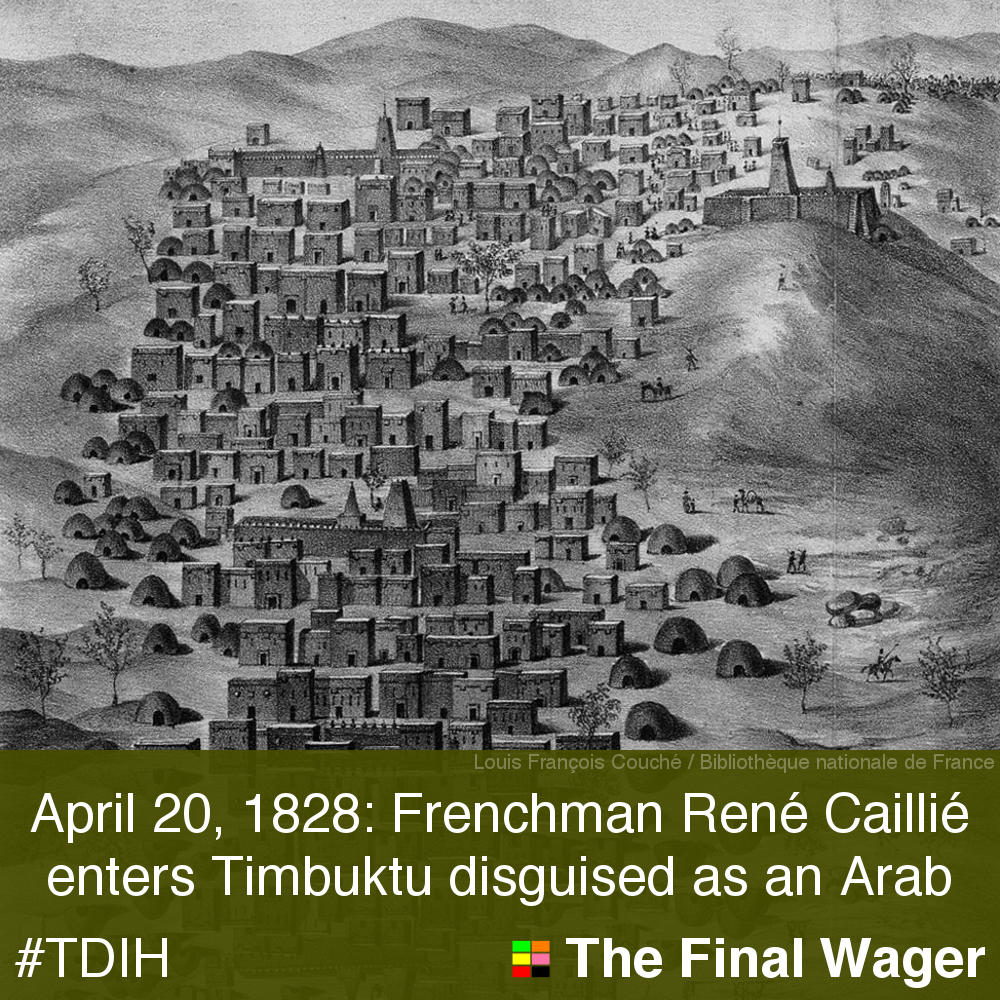
Even today, the name conjures a far-off, mysterious place – and it actually does exist. On this day in 1828, Frenchman René Caillié entered the fabled city of Timbuktu.
Now part of present-day Mali, Timbuktu was, for several centuries, an important trade center. Its location in the semiarid zone between the Sahara Desert and the Niger River meant it was a place where land and water routes could cross. Gold and ivory were exchanged for salt; its numerous Islamic scholars made it a center of learning.
Tales of its riches filtered north, piquing the interest of many brave (or foolhardy) souls.
Caillié wasn’t the first European to get there, but he was the first to – verifiably – successfully return. Mungo Park, a Scotsman, might have reached it in 1806, but died on the Niger River coming home; his countryman Gordon Laing definitely got there in 1826, but was killed by locals who wanted to keep its location secret.
Tempted by a 10,000 franc prize, but scared of Laing’s fate, Caillié spent nearly a year in Mauritania, learning Arabic and Islamic customs. After another year in transit, he spent two weeks in Timbuktu, disguised as an Arab, before returning to France for his reward.
Only three other Europeans would visit before the French army took the city in 1893.
For more on Timbuktu, visit Timbuktu Heritage.